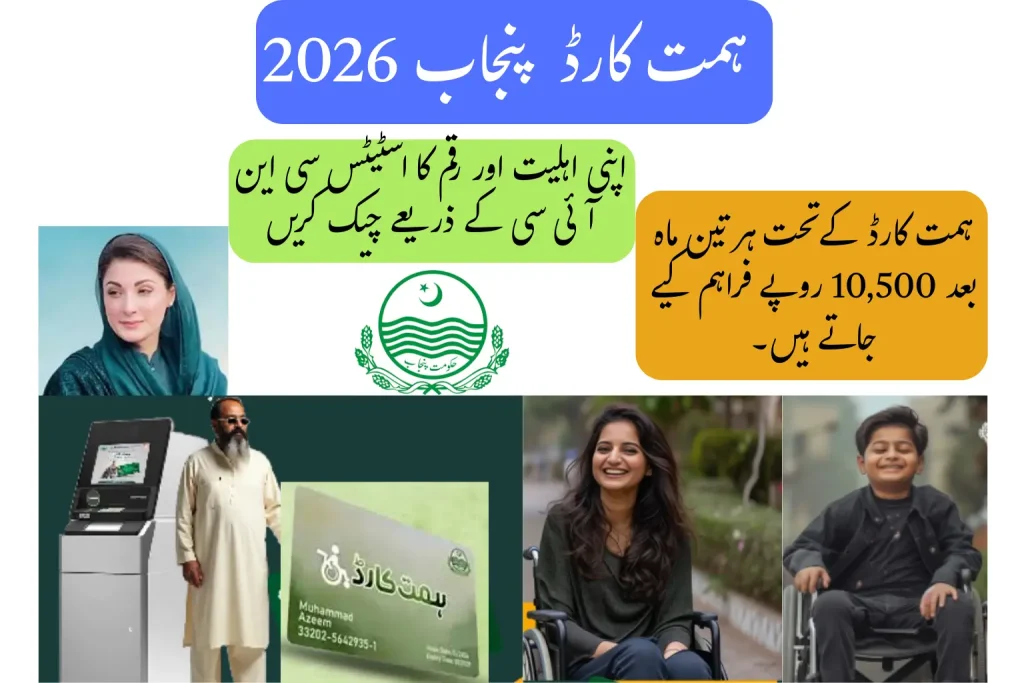
The Himmat Card Punjab is a welfare program that gives Rs. 10,500 every three months to persons with disabilities who are unable to work. The amount is provided through an ATM card after official verification. Like the Benazir Income Support Program, this initiative supports vulnerable people, but it is specifically designed for disabled individuals living in Punjab.
In 2026, the program continues with the same core rules, while payments are released in phases to ensure transparency and fair distribution.
The Himmat Card is a quarterly cash assistance program for people with disabilities who cannot earn due to physical or mental limitations. Instead of temporary relief, it offers regular financial support so beneficiaries can manage daily needs such as food, medicine, and basic household expenses.
This program does not work through open online applications. The government uses existing records, which is why many people believe they applied even though the system only checked their data.
Who is eligible for the Himmat Card in 2026?
Eligibility is the most critical part of the Himmat Card program and also the most misunderstood. Disability alone does not guarantee approval. The government approves only those individuals who are officially marked unfit to work and also fall under the poverty threshold.
A person qualifies for the Himmat Card only if all of the following conditions are met:
The person is a resident of Punjab
The disability is officially certified
The person is declared unfit to work
The PMT score is 45 or below
The person is not employed anywhere
The person is not receiving BISP, Zakat, pension, or similar aid
If even one condition is missing, the system automatically marks the status as not eligible.
Is there a women quota in Himmat Card?
Yes. Under the Himmat Card program, 30% of the total quota is reserved for women with disabilities. This rule helps ensure fair access for women who often face greater financial hardship.
How much money does the Himmat Card give?
The Himmat Card provides Rs. 10,500 every three months. This amount is fixed across Punjab and does not change based on district, gender, or type of disability.
Payments are released in phases, which means some beneficiaries receive money earlier while others may have to wait even if both are eligible.
Detail
Information
Amount
Rs. 10,500
Payment cycle
Every 3 months
Payment method
ATM / biometric card
Coverage area
Punjab
Beneficiaries
Persons with disabilities
How to check Himmat Card status by CNIC
Many people search for “Himmat Card status check” without understanding how the system works. There is no manual application tracking like other programs.
How status checking actually works
Your CNIC is matched automatically with government records. The system checks disability certification, poverty score, employment status, and existing welfare benefits. Based on this data, your status appears as eligible, not eligible, or under verification.
If your status shows not eligible, it means your data does not meet program rules. Waiting longer will not change the result unless official records are corrected.
How does Himmat Card verification work?
Verification is automatic, not manual. This is why agents or middlemen cannot help.
What happens during verification?
The system reviews CNIC information, disability status, poverty score, and welfare history. If any record is missing or outdated, approval is blocked. There is no interview and no payment request involved.
In 2026, verification rules remain the same to maintain fairness and prevent misuse.
Why does the system show “not eligible”?
Seeing “not eligible” often causes confusion and frustration. In most cases, it does not mean the person is ignored. It means the records do not meet policy conditions.
Common reasons for rejection
The most common issues include a PMT score above 45, receiving another government allowance, disability not marked as unfit to work, or outdated data. The government has not published exact rejection numbers, which is why many rumors circulate online.
Is the Himmat Card different from BISP?
Yes, and understanding this difference helps avoid confusion.
Difference between Himmat Card and BISP
BISP supports low-income families, while the Himmat Card supports individuals with disabilities who cannot work at all. A person cannot receive benefits from both programs at the same time. This rule helps distribute resources fairly and avoids duplicate payments.
When will Himmat Card payments be released in 2026?
Payments are released quarterly, but there is no fixed public date. The release depends on verification completion and budget approval.
If a person is approved, the amount is transferred automatically. If the status is not eligible, waiting longer will not change the result unless records are officially updated.
Payment delay due to expired CNIC
Sometimes, Himmat Card payments are delayed even after approval because the beneficiary’s CNIC has expired. During payment processing, the system blocks disbursement if CNIC data is invalid or outdated. In such cases, the CNIC must be renewed and biometric verification completed so the payment can be released in the next payment cycle.
It is used to withdraw quarterly cash assistance through ATMs for daily living expenses.
Can a disabled child receive the Himmat Card?
Yes, if officially certified and declared unfit to work, with verified household data.
Is there a quota for women?
Yes. Thirty percent of the program quota is reserved for women with disabilities.
Is online registration required?
No. The program does not accept public applications and works through existing records.
What should I do if my CNIC shows not eligible?
You should ensure your disability status and poverty data are correctly updated in official records.
Conclusion
The Himmat Card Punjab 2026 is a focused welfare program created for people who genuinely cannot earn due to disability. It is not a general relief scheme and does not work through online registrations shared on social media.
If your records meet the criteria, the support is steady and respectful. If not, the system reflects policy rules rather than personal decisions. Keeping official data accurate is the best way to avoid problems.